

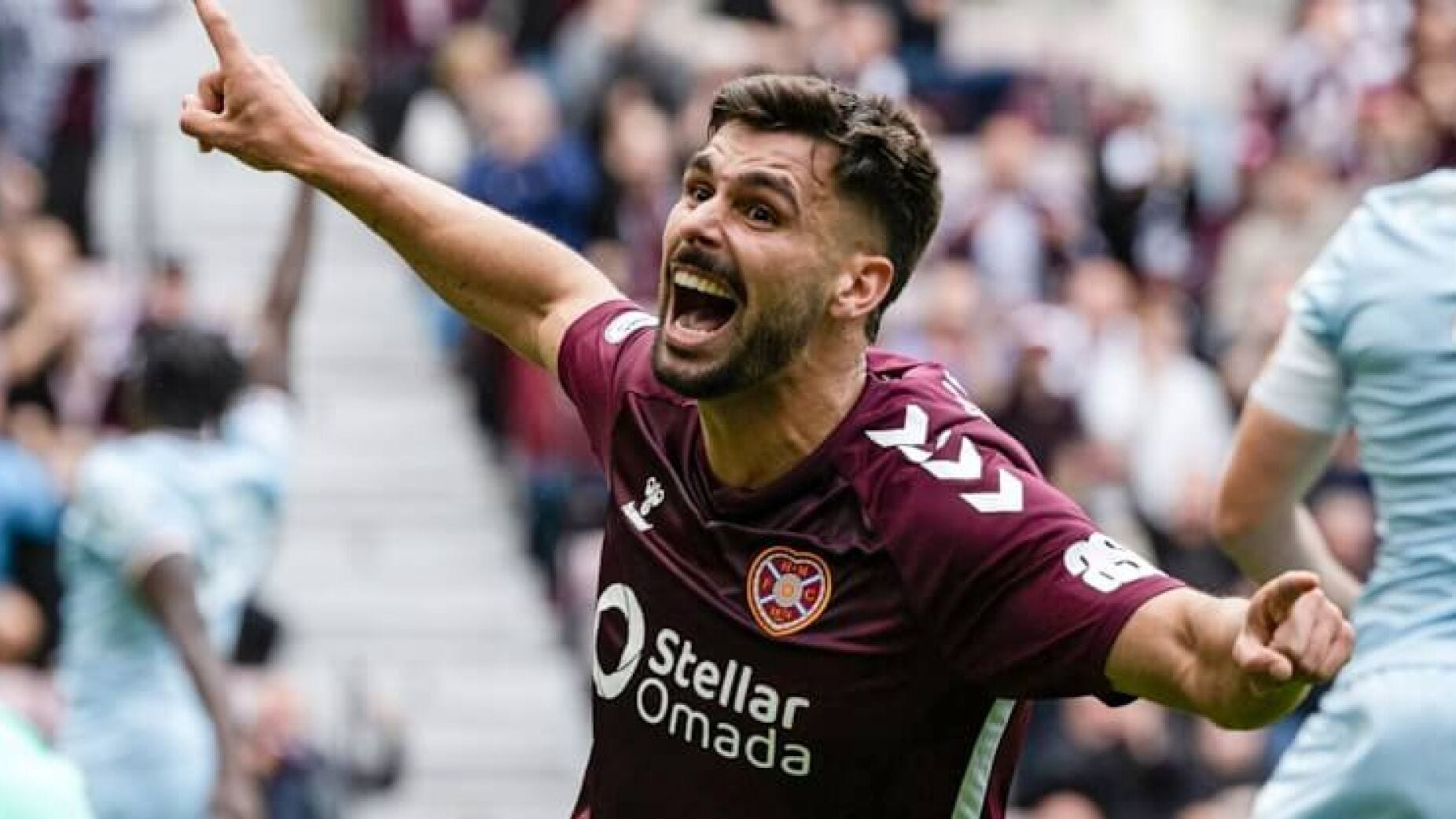
As we enter 2026, there is an unexpected sight in the Scottish Premiership, as Heart of Midlothian sit proudly on top of the table, ahead of the Glasgow giants.
Of course, Hearts have been greatly helped by the disastrous campaigns to date by Celtic and Rangers, who have both dismissed their managers with Brendan Rodgers and Russell Martin being shown the door.
It remains to be seen whether Hearts will be able to last the distance, but it feels like something might just be changing in Scottish football, where the title has been the property of the two Glasgow clubs for the last 40 years.
In the meantime, Hearts chief executive Andrew McKinlay summed up the thoughts of most fans, “I mean it’s impossible not to be delighted with where we are.”
Bloom Baby Bloom
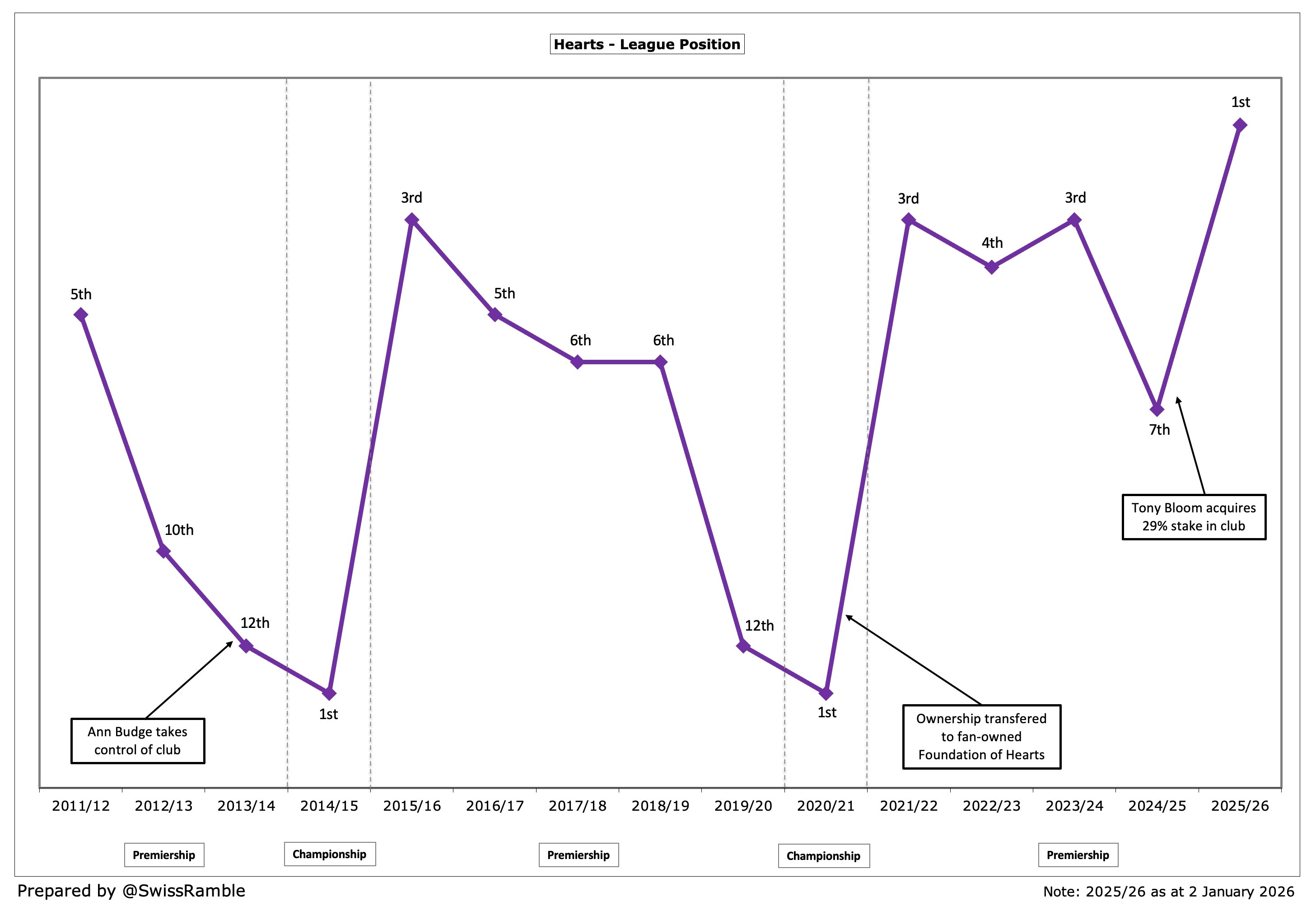
Hearts’ dramatic improvement this season owes a lot to Tony Bloom’s investment in the club in June, when the Brighton owner paid £9.86m for a 29% stake in the club in non-voting shares. This change was overwhelmingly voted through by 98.5% of Foundation Of Hearts (FOH) members.
Bloom has installed James Franks on the club’s board as his representative, but control remains in the hands of the FOH supporter movement.
He said, “My involvement is very much in the background. I’m not involved at all in the day to day. That’s the role of the executive team and the board of directors at Hearts.”
Bloom’s arrival led to what the board described as perhaps “the most significant relationship in the club’s recent history”, as Hearts became the sole Scottish partner of Jamestown Analytics, the world’s leading football data analysis firm.
The club explained, “It is anticipated that this partnership will revolutionise the club’s recruitment processes and bring to life its player trading model.”
From an investor’s perspective, Hearts ticked many boxes, as the club is located in a wealthy city, attracting millions of tourists, while it has a of potential on the pitch.
Bloom explained, “I just thought there was an opportunity here to shake things up in Scotland. I think we’ve got a very good chance of at least being second this season.”
Indeed, he went further, “If we have not won the league title in the next 10 years, I will be very disappointed. I want to make sure that we are in the talk to win the title at the start of each season.”
Although new owners often bang the drum in this way, Bloom should be taken more seriously, as he has a solid track record at his other clubs, which have made good use of his team’s algorithm.
Obviously, Brighton have flourished since promotion to the Premier League, but possibly of more relevance to Hearts is his achievement at Union Saint-Gilloise, who were bottom of Belgium’s second tier when he took over in 2018, but then proceeded to win the Belgian top flight for the first time in 90 years.
Indeed, Jamestown’s influence was very much in evidence this summer, when Hearts brought in no fewer than ten new players from lesser known territories such as Norway, Slovakia, Iceland and Estonia, as well as Germany, Portugal and Belgium, only splashing out around £3m in total.
Ann Budge’s Role
Following the successful completion of Bloom’s investment, Ann Budge announced that the time was right for her to stand down after an 11-year involvement.
Budge played a huge role in the Hearts’ survival after the club was placed into administration in 2013, deducted 15 points and then relegated to the Scottish Championship.
She took ownership in June 2014 in partnership with the Foundation of Hearts, following the misguided Romanov regime.
In August 2021 Budge signed over 75% of her shareholding to the Foundation, making Hearts the largest fan-owned club in the UK. The club described this as “Heart & Soul Day”.
Budge said, “I’m beginning to feel that I’ve done everything I can do for the club and it’s now time to move into a different kind of business and have different people leading it.”
2024/25 Season
This season is already a big improvement on 2024/25, where the club said that “results on the pitch were extremely disappointing” and “failed to live up to the standards required”.
In fact, Hearts finished a relatively low 7th, thus failing to secure a top four spot in the Scottish Premiership for the first time since promotion. They also lost to Aberdeen in the Scottish Cup semi-final, were beaten by Falkirk in the second round of the Scottish League Cup and failed to qualify for the knockout round of the UEFA Conference League.
Managerial Changes
This led to much upheaval, as Hearts parted company with two permanent Head Coaches in the season.
Steven Naismith was dismissed in September, replaced by Neil Critchley, but the former Blackpool manager went the same way in April, as Hearts struggled to cope with the additional workload imposed by the return to Europe.
However, control then passed to a safe pair of hands, as Derek McInnes was given a 4-year contract in May. He is very experienced in managing a Scottish club, as he has previously led Kilmarnock, Aberdeen and St Johnstone, as well as having a stint at Bristol City.
Let’s take a look at the financial situation of the club before Bloom got involved, based on the latest 2024/25 accounts.
Profit/(Loss) 2024/25
The club said that the “poor on pitch performance” had impacted the finances, though it had still delivered a “robust set of accounts”.
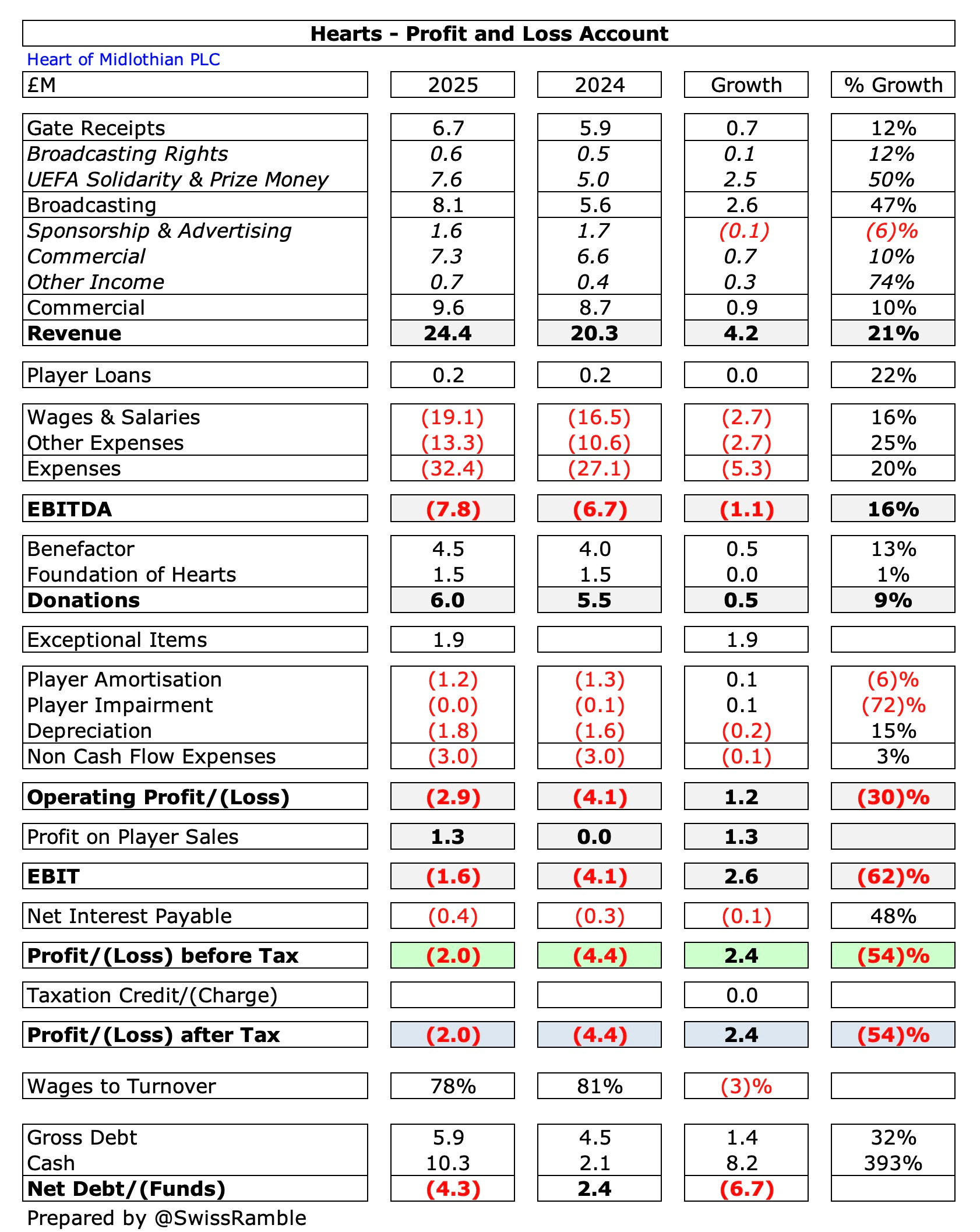
As a result, Hearts’ pre-tax loss more than halved from £4.4m to £2.0m. Revenue rose £4.1m (21%) from £20.3m to a club record £24.4m, while they made £1.3m profit on player sales compared to just £5k the previous season.
As always, Hearts benefited from £6.0m donations from benefactors and the Foundation of Hearts, up 9% from the prior year’s £5.5m, while there was also a £1.9m accounting gain from the revaluation of a benefactor loan.
This was partially offset by £3.5m (12%) growth in operating expenses from £30.1m to £33.6m.
Hearts noted that the significant increase in revenue was driven by “a strong commercial performance and our participation in European League Phase football”.
In fact, all three main revenue streams saw good growth, led by broadcasting, which shot up £2.5m (47%) from £5.6m to £8.1m. In addition, commercial rose £0.9m (10%) from £8.7m to £9.6m, while gate receipts increased £0.8m (12%) from £5.9m to £6.7m.
In addition, player loans were unchanged at £0.2m.
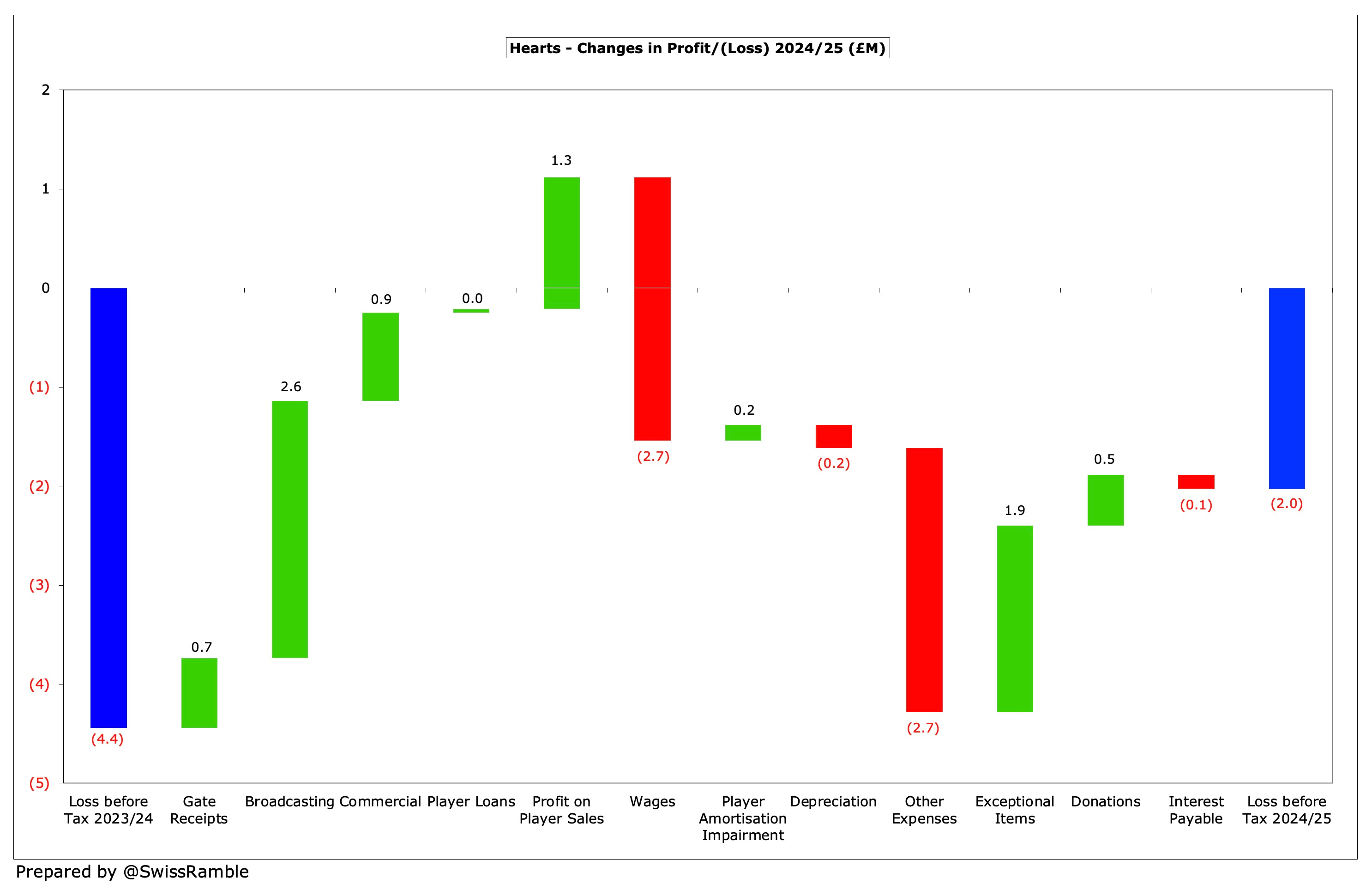
Hearts continued its investment in the playing squad and support staff, so the wage bill rose £2.6m (16%) from £16.5m to £19.1m, though player amortisation fell slightly from £1.3m to £1.2m.
Other expenses surged £2.7m (25%) from £10.6m to £13.3m, while depreciation was up £0.2m (15%) from £1.6m to £1.8m.
Following the improvement last season, Hearts’ £2.0m pre-tax loss was in the middle of the pack in the Scottish Premiership. On the one hand, this was miles behind Celtic’s staggering £45.7m profit, but at the same time it was a lot better than Rangers’ £14.9m loss.
