

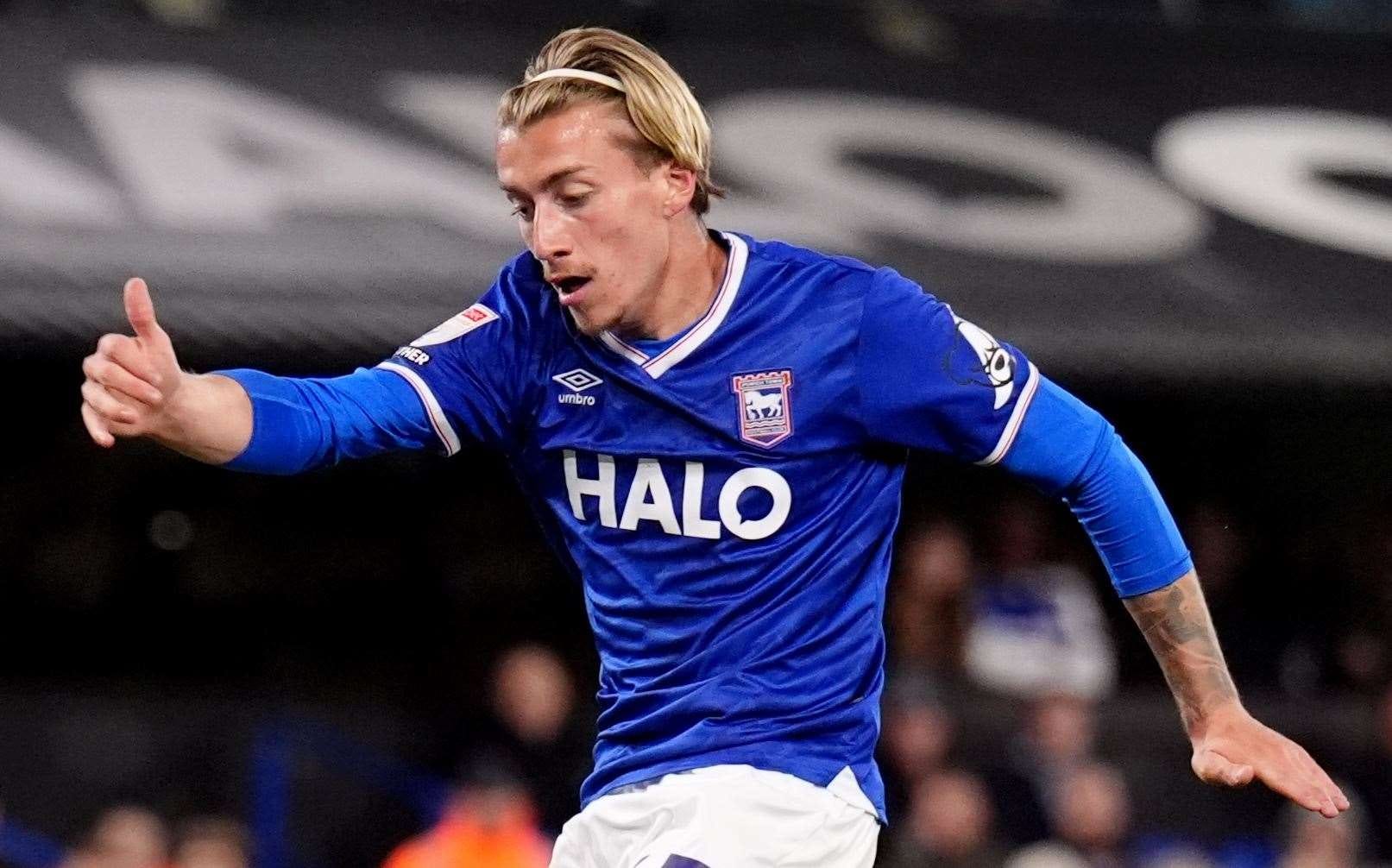
After achieving a second promotion to the Premier League in three seasons, it came as something of a shock when Ipswich Town’s head coach Kieran McKenna decided to step down in order to take break from management and dedicate some time to his family.
He has been replaced by Gary O’Neil, who will hope that Ipswich have a better time in the top flight than their experience two years earlier, when they finished 19th with just 22 points, so dropped straight back down to the Championship.
O’Neil certainly seems confident, “I’m 100% sure that we will stay in the Premier League this season. I sit here right now and there are no doubts in my mind. Belief is a big factor. I know we can achieve our goal this season.”
In fairness, he has twice managed to keep teams up in challenging circumstances, first with newly promoted Bournemouth in 2022/23, then with Wolves the following season after the Midlands club had sold many of their talented players, so he has already “walked the talk”.
This positivity is shared by chairman Mark Ashton, “We can’t go in with a mentality that fourth from bottom would be success. If you start with that, I think it’s defeatist. I think we’ve got to be more optimistic than that.”
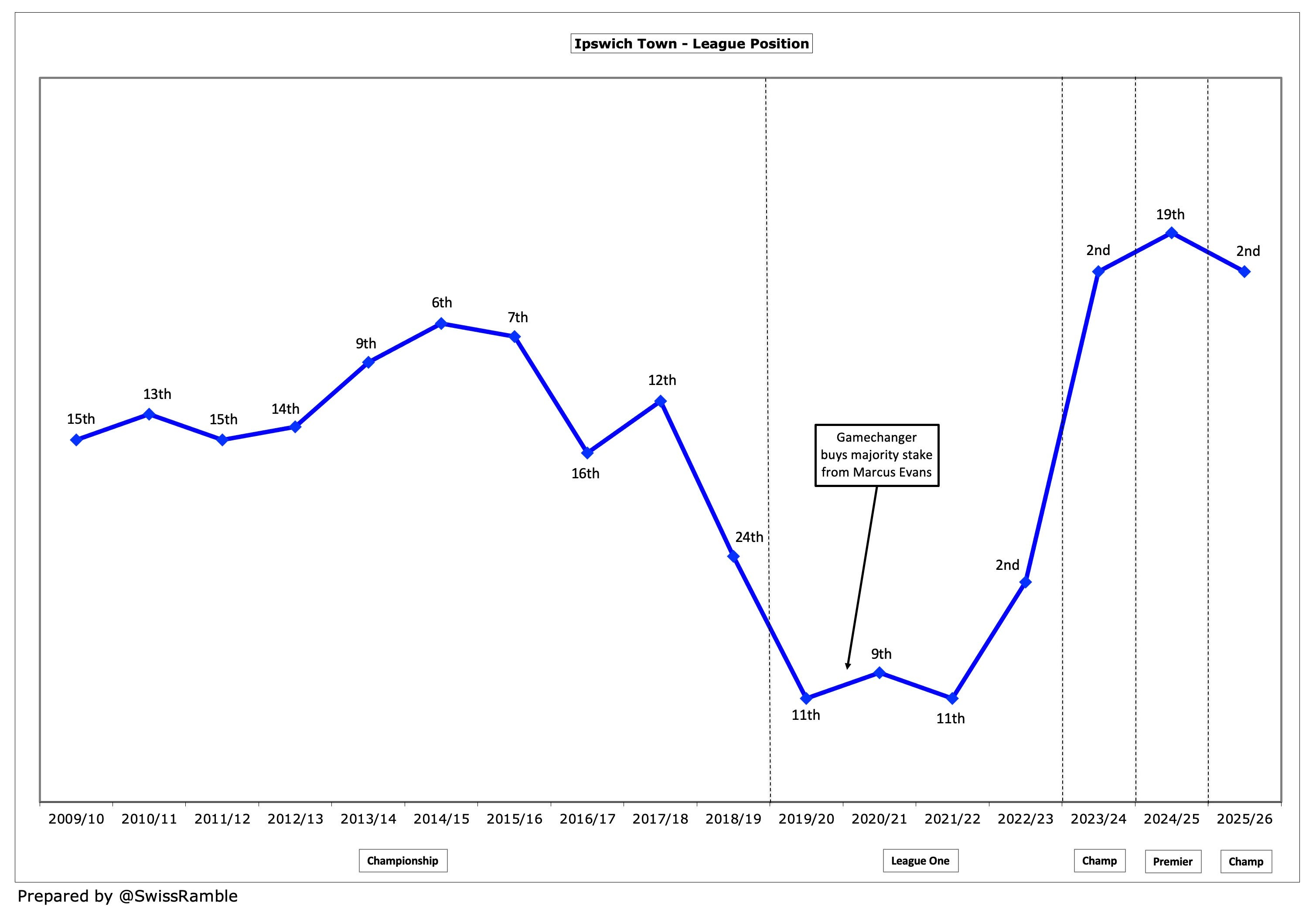
League Position
However, given their struggles the last time they went up, supporters would be entitled to have some doubts about these bullish statements, though Ashton tried to explained why things might now be different.
The chairman said, “The last time we were up, we’d been outside the top flight for over two decades. We’d only had one season in the Championship. The problem that you’ve got with that is you can’t build infrastructure and processes quickly enough. I think ultimately that caught up with us. This time, recruitment, performance and data are all more robust.”
His point is understandable, given Ipswich’s dramatic ascent up the leagues. After languishing in England’s third tier for four seasons, they then enjoyed back-to-back promotions from League One and the Championship, which paved the way for their return to the Premier League after 22 long years.
Ownership
Ipswich’s transformation has been driven by the new owners, who purchased the club in April 2021 for a reported £40m. As a result, Ipswich Town are now majority owned by the appropriately named Gamechanger 20 Limited, though the ultimate owner was the Arizona state pension fund, the Public Safety Personnel Retirement System (PSPRS), via its investment firm, ORG.
The new ownership group has certainly put its money where its mouth is to date, investing a lot in the squad and the club’s infrastructure.
They were helped by the previous owner, Marcus Evans, writing-off the vast majority of the club’s debt as part of the takeover, but it’s fair to say that the new owners provided the catalyst for Ipswich’s renaissance.
There have been a few changes since the initial investment, as Bright Path Sports Partners, a US private equity firm specialising in professional sports franchises, invested “up to £105m” for a 40% minority stake in March 2024.
Subsequently, in December 2025 ORG sold a large chunk of its shares to Portman Holdings LLC, though remain a significant investor. Portman Holdings also include Clara Vista Partners and the Three Lions Fund.
Following this transaction, it looks like ORG has around 45%, while Bright Path has about 40%, with a small stake for Three Lions (i.e. businessmen Brett Johnson, Berke Bakay and Mark Detmer) and 1.4% for singer Ed Sheeran, a lifelong Ipswich fan.
Most strikingly, the latest transaction valued Ipswich Town at £350m, which was a eyebrow-raising figure for a club that was in the Championship at the time.
Little wonder that PSPRS chief investment officer Mark Steed observed, “Our investment in Ipswich Town has been an incredibly important one, both in terms of everything the club has achieved as well as the clear benefits it has brought to our members when you consider the value we have secured when compared to the original investment in 2021.”
Chairman Mark Ashton, who will continue to lead the club on a day-to-day basis, said: “This is another important day, as we continue to ensure the club is in the best place to maintain what has been an exceptional growth curve over the last few years.”
2024/25 Season
However, there was a blip in Ipswich’s progress in 2024/25, when relegation was confirmed after just one season back in the top flight - along with the other two teams that came up the year before.
This was the second season in a row that all three promoted clubs went straight back down, underlining the increasing struggles for clubs coming up from the Championship.
Indeed, Ashton described Ipswich’s season in the Premier League as “Brutal. It’s been a huge learning curve.”
McKenna was less blunt, but essentially made the same point, “This year has been a challenge, it was always going to be a challenge.”
Finances
This was highlighted by Ipswich’s financial results in 2024/25, which revealed the massive disparity with other clubs in the Premier League,
Although these accounts are obviously now a year out-of-date, they do provide a good indication of the challenges that Ipswich will have to face again in the Premier League in the coming season.
Profit/(Loss) 2024/25
Following promotion to the Premier League, Ipswich swung from a substantial £39.3m pre-tax loss to a £4.0m profit, driven by a steep rise in revenue, which more than quadrupled from £37.3m to a club record £155.4m.
In addition, profit on player sales improved from £1.2m to £15.4m, while other operating income tripled from £1.5m to £4.6m.
This was partly offset by an increase in operating expenses, which more than doubled from £79.3m to £166.2m, while net interest payable was up from basically zero to £5.2m.
The club admitted that the profit was something of a double-edged sword, “Whilst this is welcomed, it is noted this was not the intention at the beginning of the season, and only resulted from the sale of playing assets prior to 30th June 2025 and a reduction in performance based bonuses versus budget.”
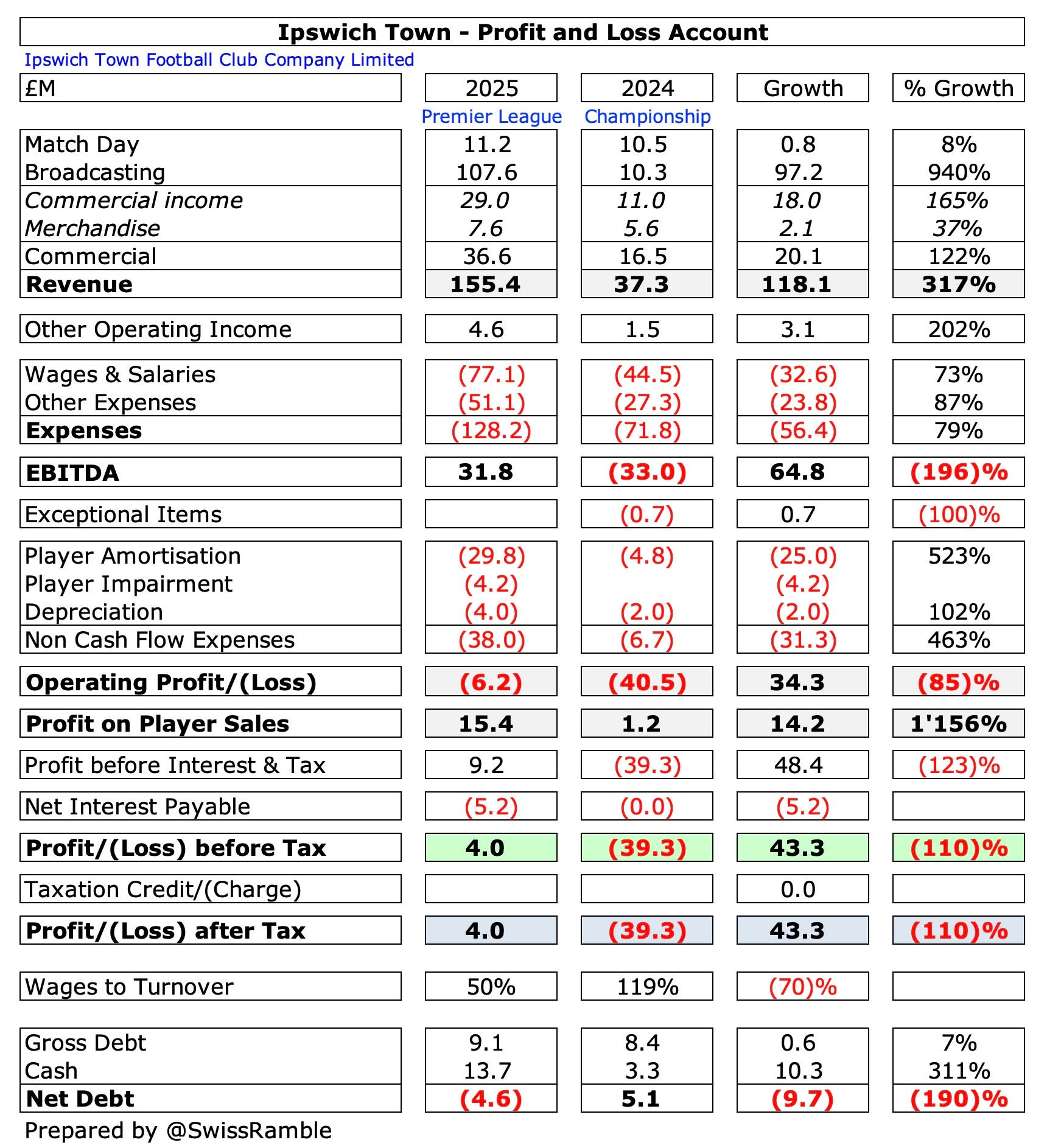
The main driver of Ipswich’s £118.1m revenue increase was broadcasting, which was up tenfold, rising by £97.3m from £10.3m to £107.6m, as TV rights are significantly higher in the Premier League than the Championship.
There was also a notable increase in commercial, which more than doubled from £16.5m to £36.6m, while match day rose £0.7m (8%) from £10.5m to £11.2m.
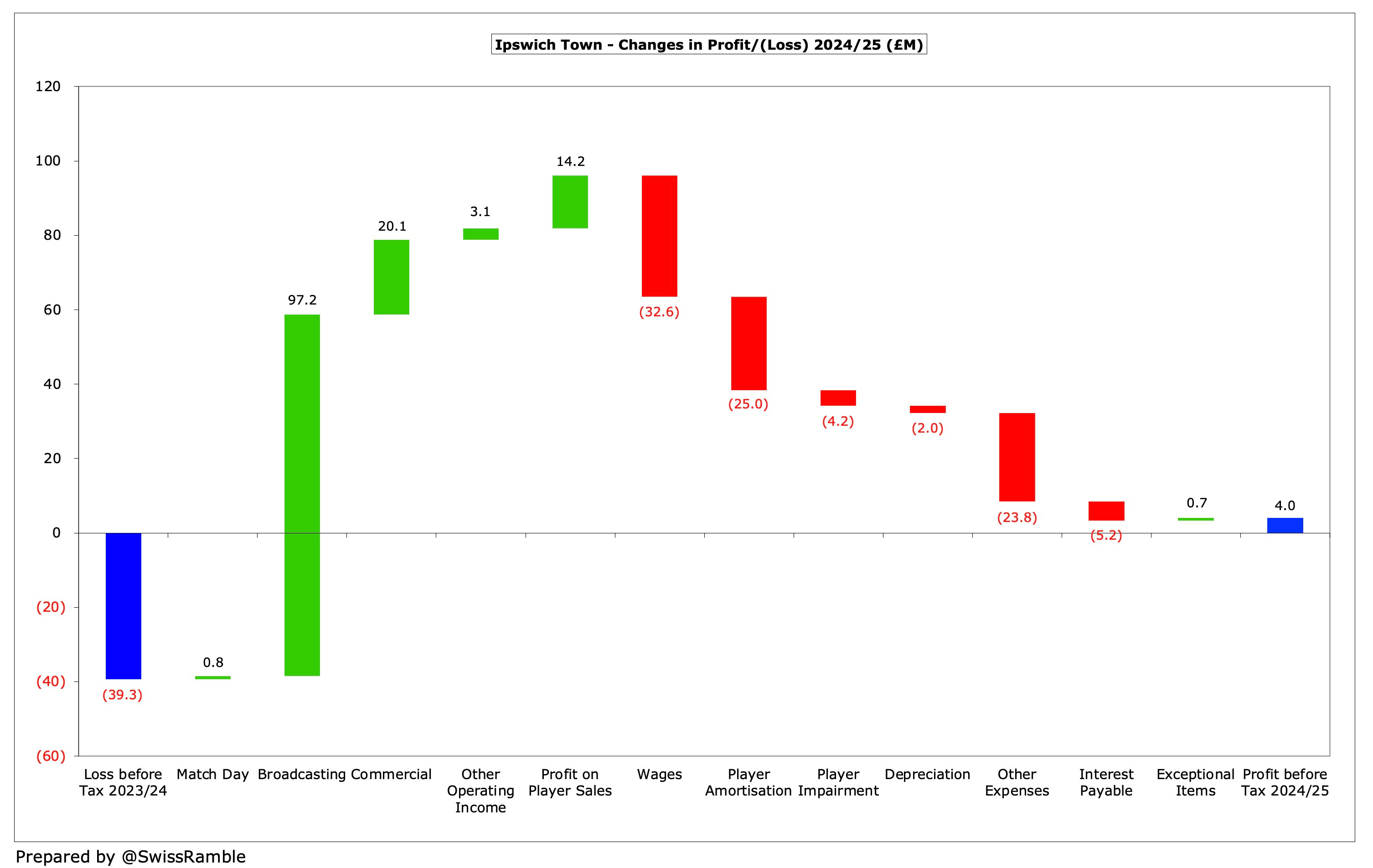
As would be expected, Ipswich had to invest in the squad after promotion to the Premier League, so wages increased by £32.6m (73%) from £44.5m to £77.1m. In addition, player amortisation was six times as much as in the Championship, rising from £4.8m to £29.8m, while the club also booked £4.2m player impairment.
In addition, there was significant cost growth elsewhere, as depreciation doubled from £2.0m to £4.0m, while other expenses shot up from £27.3m to £51.1m.
Ipswich were one of only four clubs that made money in the 2024/25 Premier League, along with Liverpool £15m, Bournemouth £15m and Crystal Palace £8m.
