


Following this summer’s record breaking spend, many people ponder the question of which club actually “won” the transfer window?
There are many ways of looking this. Some might think that it is simply a question of which club has splashed out the most cash (a media favourite), while others will attempt to grade the quality of the signings.
However, in the era of Profitability and Sustainability Regulations (PSR), another way of assessing this is to look at the impact on a club’s profit and loss account.
As a football fan first and foremost, this would not necessarily be my preferred metric, but it has clearly become an important element in any club’s transfer strategy.
Player sales are often viewed as an easy solution for those clubs striving to comply with PSR, and there’s some truth in that, but people should really look at player trading as a whole to fully understand the overall impact on a club’s finances.
Supporters have become increasingly familiar with concepts such as amortisation, swap deals and “pure profit”, but player trading is a fairly complex subject (at least from an accounting perspective).
Therefore, today’s article will look at the accounting impact for each premier League club, split between:
Player amortisation
Profit from player sales
Net player trading impact
Transfer Spend
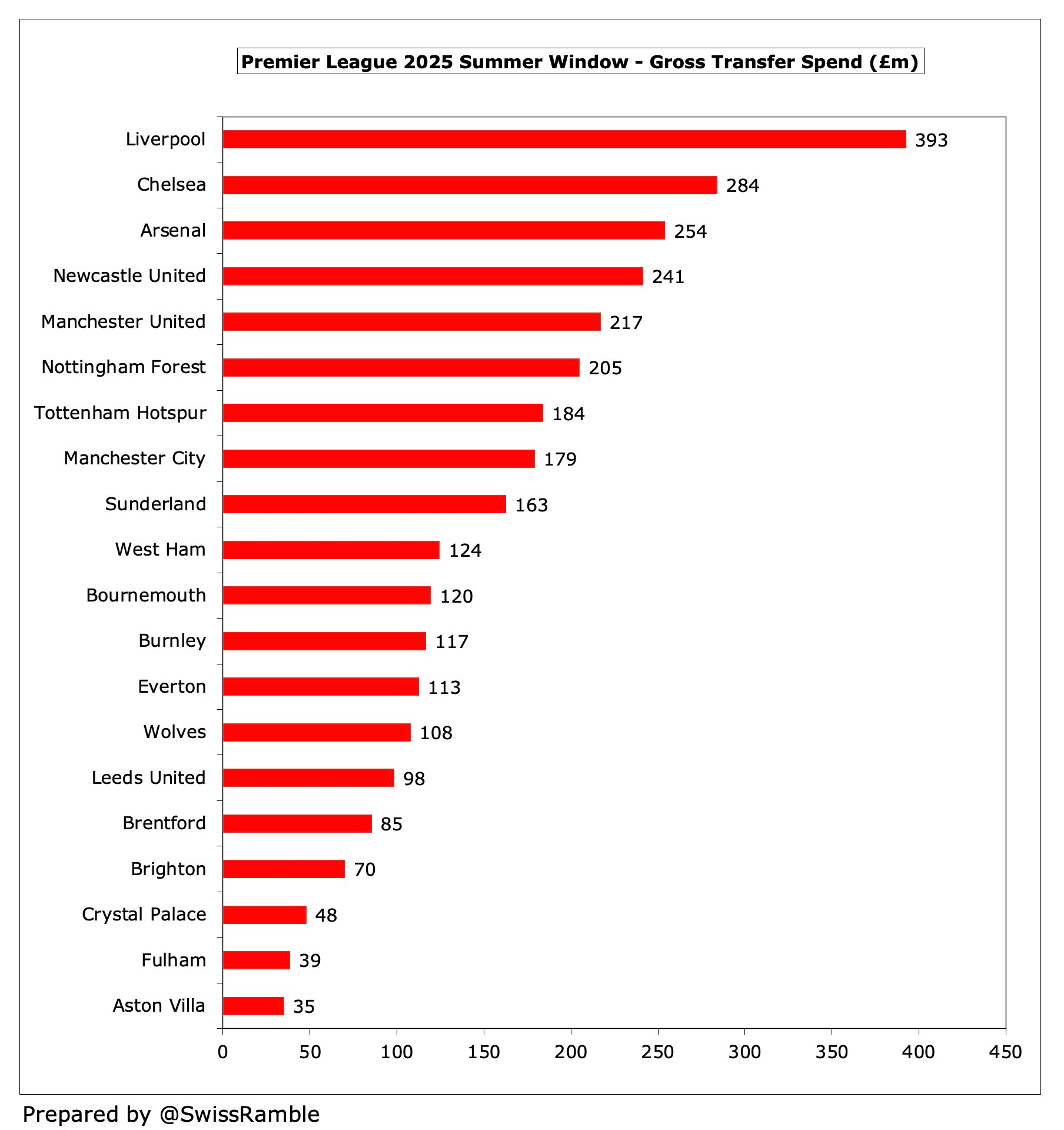
Looking at pure transfer fees, Liverpool had the highest gross spend of £393m, followed by Chelsea £284m and Arsenal £254m, though a total of six clubs in the Premier League spent more than £200m, which is a staggering statistic.
In addition, the three promoted clubs all spent a fair amount, led by Sunderland’s £163m, though Burnley £117m and Leeds United £98m did not exactly hold back either.
On the other hand, three clubs spent less than £50m: Crystal Palace £48m, Fulham £39m and Aston Villa £35m. The Midlands club faced PSR challenges after a few years of high spending, though in general the financial regulations were not a major factor in the transfer activity this summer.
Total Cost
The total cost of transfers ultimately booked in the accounts is even higher, as this will include various other payments on top of the transfer fees:
Agent fees – which we have assumed to be 10% of the transfer fee.
Solidarity payment – 5% of the transfer fee, distributed to all clubs that trained the player between his 12th and 23rd birthdays, applied on international transfers.
Premier League levy – 4% of the transfer fee, applied on all transfers (both domestic and international).
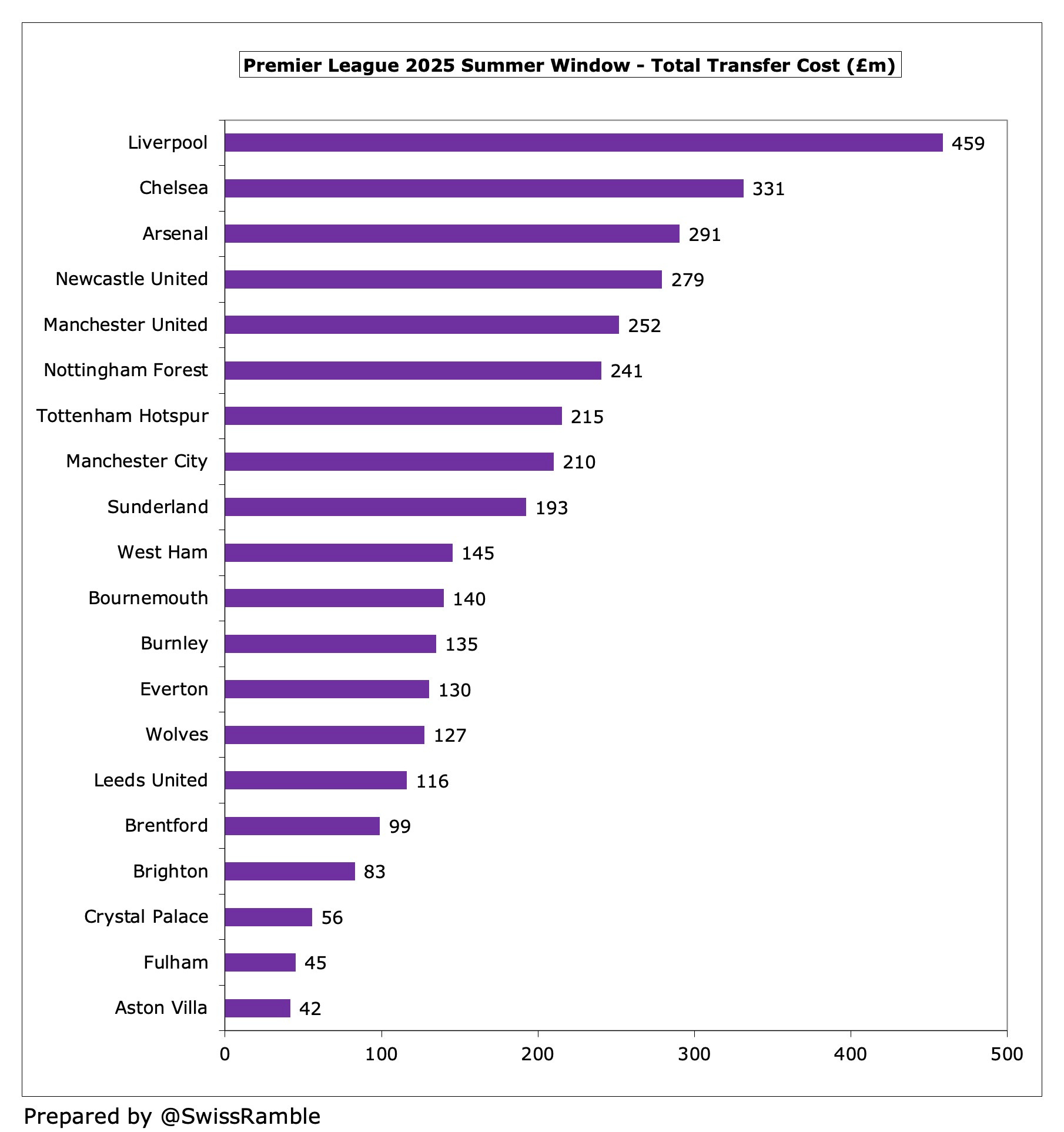
These additional fees can make a big difference to the total cost of a transfer, e.g. we estimate these to add up to over half a billion Pounds on this summer’s transactions, which works out at around 17% of the £3.1 bln transfer fees, taking the total cost to £3.6 bln.
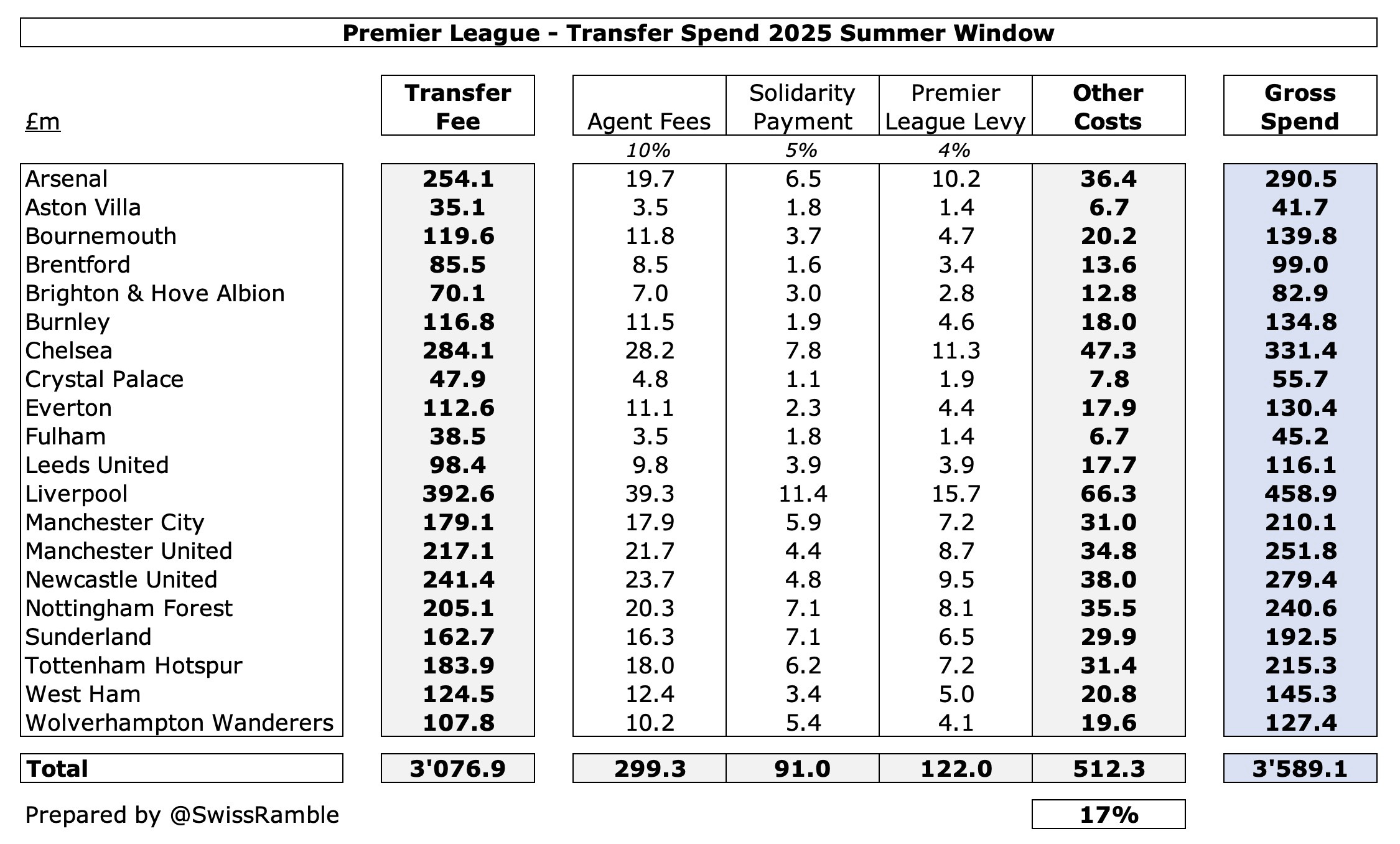
As an example, we reckon that these additional fees would take Liverpool’s accounting cost of transfers up to £459m, made up of transfer fees £393m, agent fees £39m, solidarity payment £11m and Premier League levy £16m.
Rules of the Road
As always, we do need to be cautious about transfer fees, which are often reported as different numbers , depending on whether they are provided by the selling club, the buying club or indeed the agent.
