

To nobody’s great surprise, as it had seemed inevitable for a long time, Wolverhampton Wanderers’ relegation to the Championship has finally been confirmed.
After a terrible start to the season, when it looked like they might even threaten Derby County’s lowest ever points total in the Premier League, they belatedly found some form, beating Liverpool and Aston Villa, as well as drawing with Arsenal, but it proved to be too little, too late.
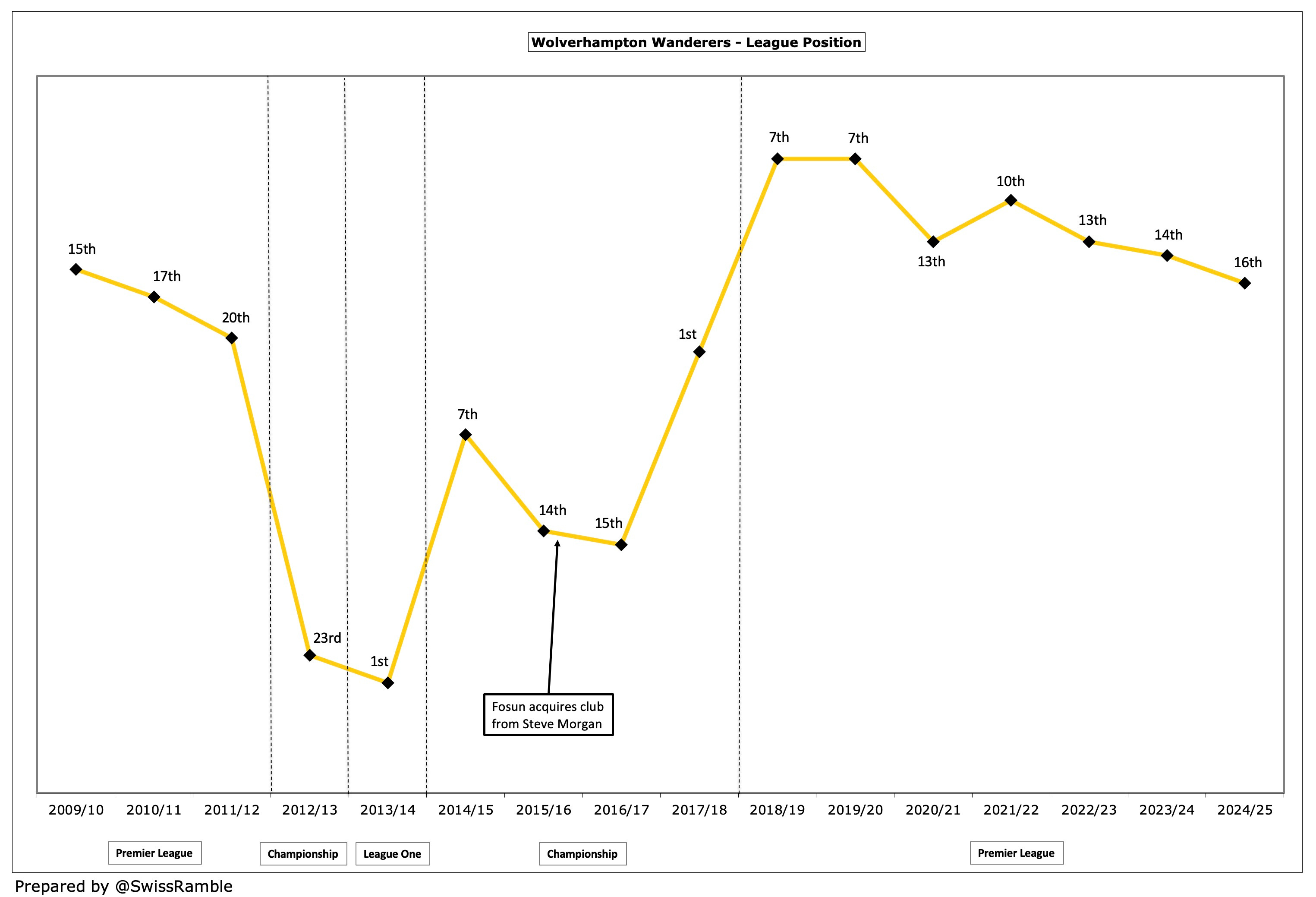
League Position
In truth, Wolves have been on the slide for a while. They had finished in an impressive seventh position in each of their first two seasons following promotion to the Premier League, but have steadily slipped down the table since then.
Owners
Much of the blame for the decline has been laid at the feet of Fosun, the Chinese owners, who acquired the club in 2016.
Their tenure started well, as Wolves first made their way out of the Championship into England’s top flight, then qualified for the Europa League, where they reached the quarter-finals, while they also got to an FA Cup semi-final.
However, since those heady days, the club has significantly cut back on its spending, contributing to the recent struggles on the pitch.
Low Transfer Spend
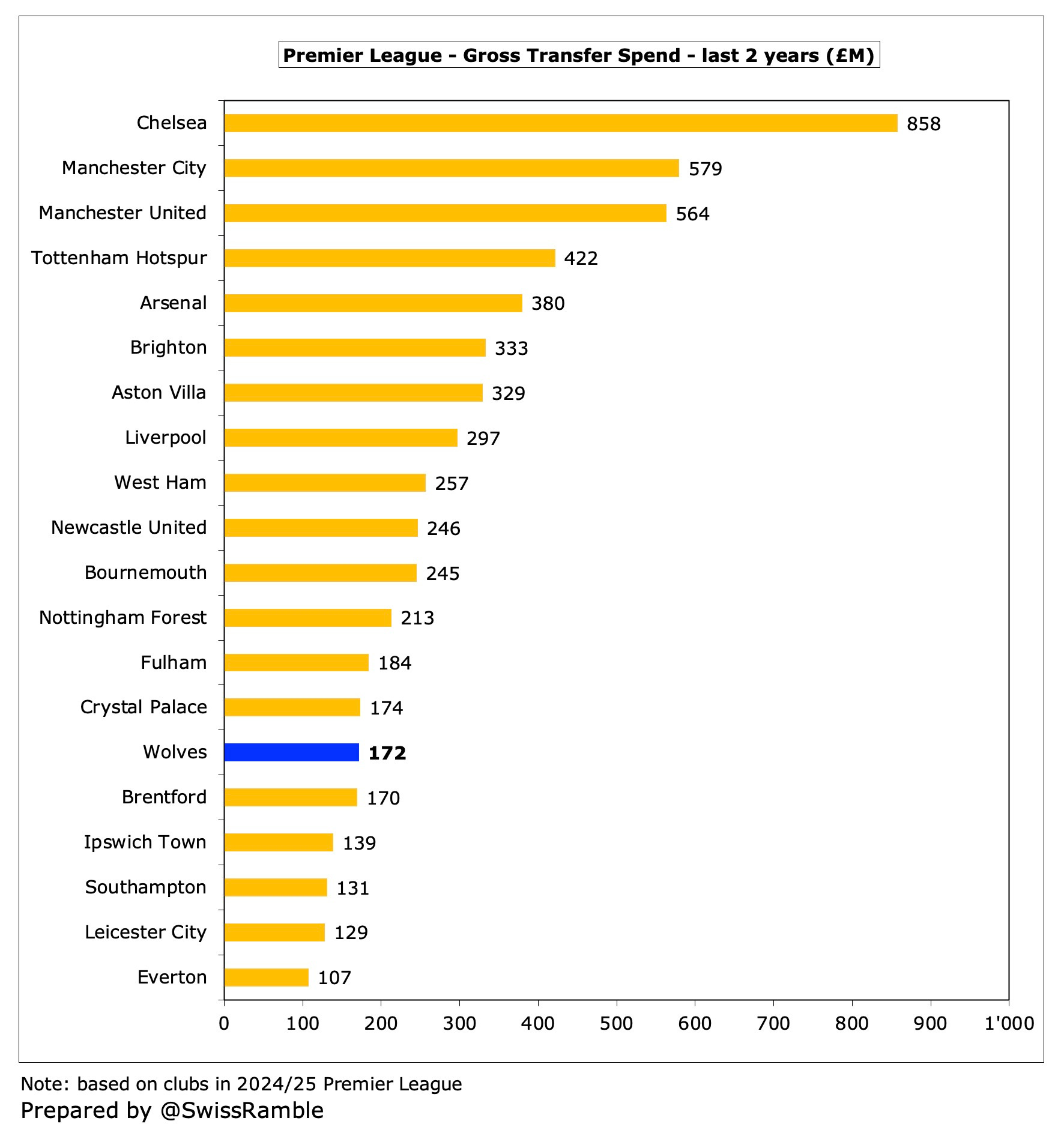
Wolves spent €172m on player purchases in the two years up to 2024/25, which might seem like a lot of money, but was very much towards the lower end of the Premier League.
In fact, this was only above the three relegated clubs, Everton (facing PSR issues) and Brentford (the masters of getting “bang for their buck”), highlighting the increasing cost of staying competitive in England’s top flight.
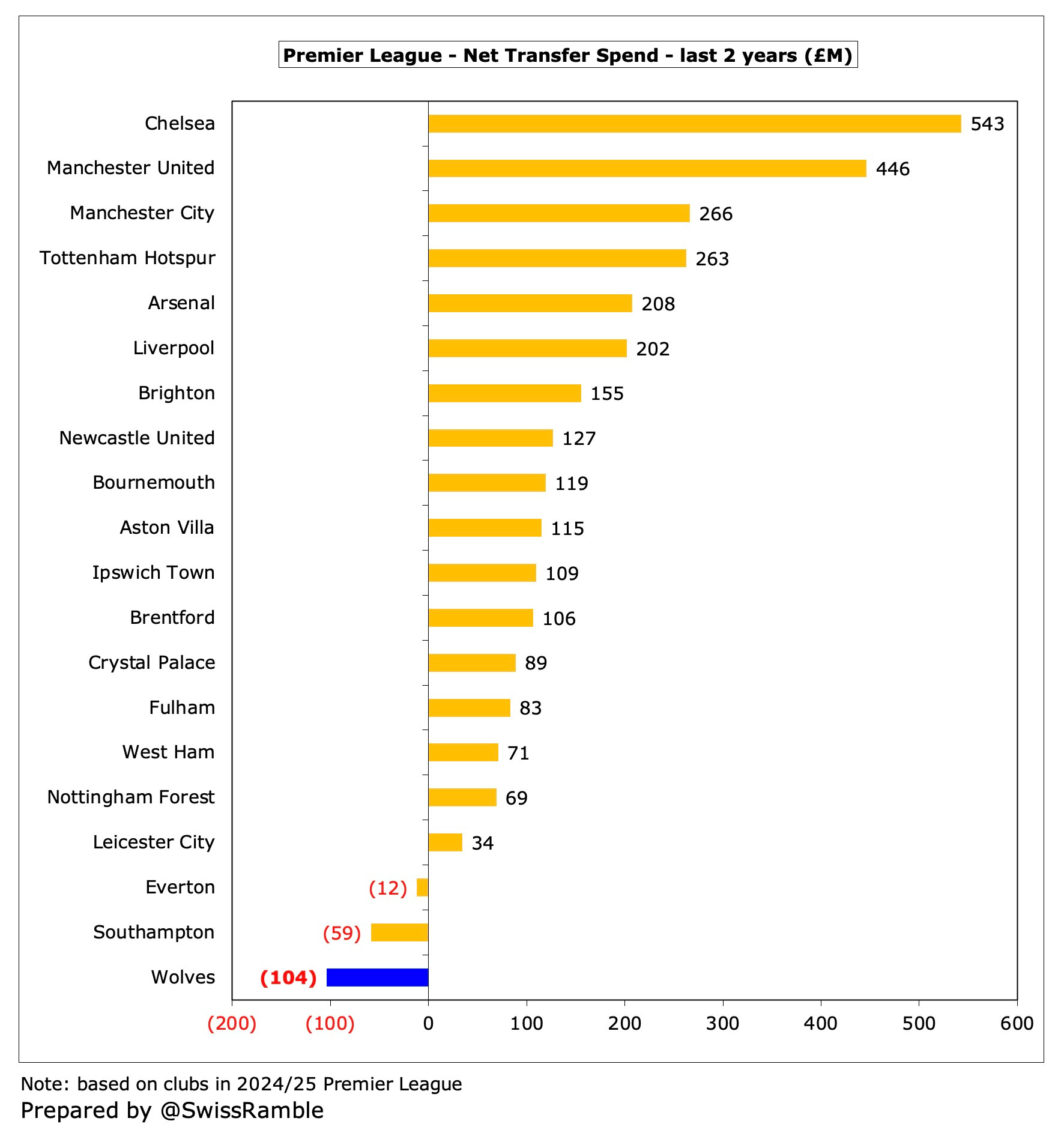
On a net basis, it’s even worse, as Wolves have frequently sold their top talent, which means they ended up with a substantial £104m net sales.
Only two other Premier League clubs had more sales than purchases in this period – and their net results were a lot smaller, namely Southampton £59m and Everton £12m.
This prompted the Wolves fans to strike up a chant against the Chinese owners during recent matches: “You’ve sold the team, now sell the club.”
Executive Departure
The poor results led to the removal of executive chairman Jeff Shi, who had been at the helm since Fosun’s takeover, but was replaced last December by Nathan Shi (no relation).
Jeff had frustrated supporters on a number of occasions, not least when he did not appear overly concerned about going down, “I feel relegation or staying up is a kind of technical word, just as I feel people try to emphasise its importance or not.”
Managerial Changes
Shi was also the man who handed lengthy new contracts to a couple of head coaches, only to sack them shortly afterwards. Gary O’Neil was dismissed in December 2024, while his replacement Vitor Pereira met a similar fate less than a year later, when he was replaced by Rob Edwards.
This means that Wolves have had no fewer than six head coaches since 2021 (plus a couple of caretakers), which has resulted in numerous changes of playing style and significant upheaval in the squad.
2024/25 Season
Let’s look at the latest available financial results from 2024/25 to see if these can help explain why the club was relegated.
These accounts covered a “challenging” season with Wolves finishing 16th, two places lower than the previous year, when the club admitted that it had been “in a battle to retain its Premier League status”.
They also reached the fifth round of the FA Cup, where they were beaten by Bournemouth on penalties, while they were eliminated by another South Coast club, Brighton, in the third round of the Carabao Cup.
13th Month Impact
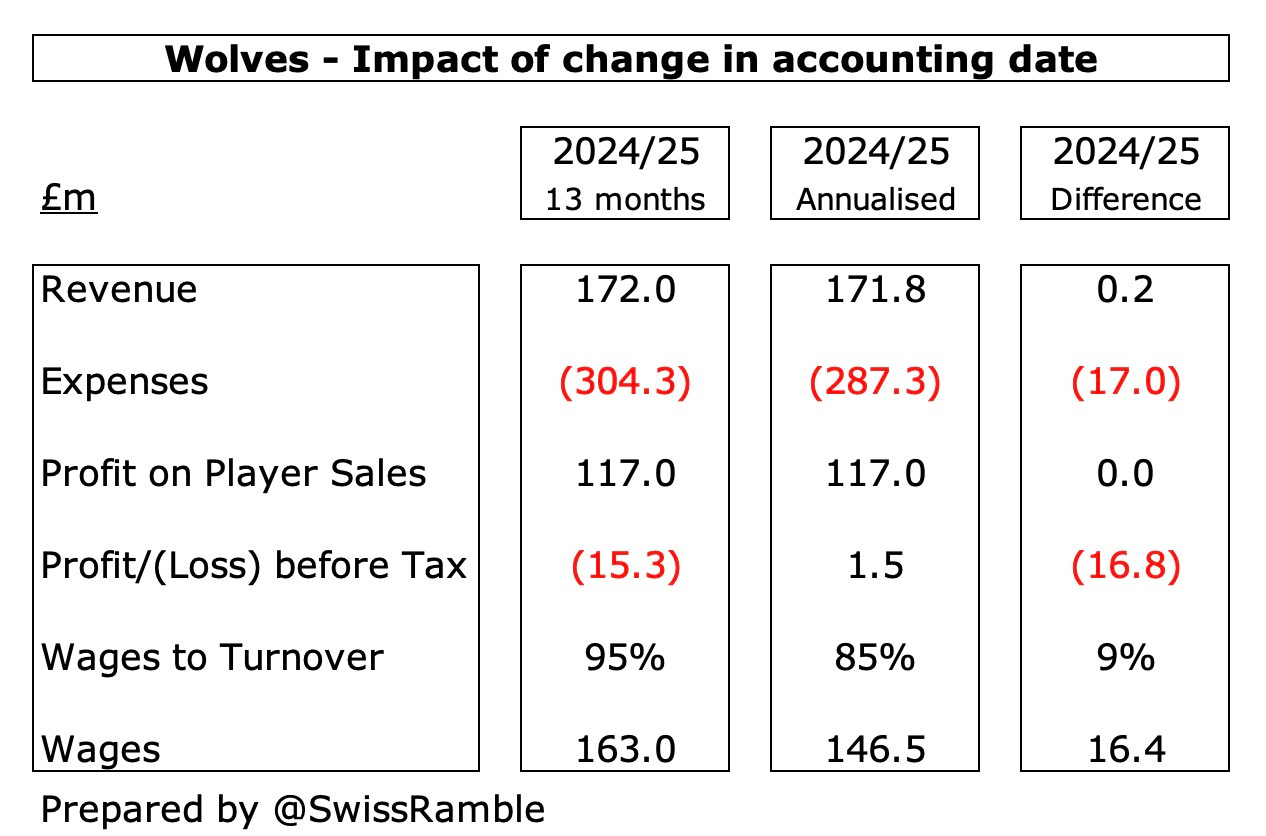
Before we start delving into the club’s finances, it’s worth noting the technical impact of the change in the year-end from May to June, which means that Wolves’ 2024/25 accounts covered 13 months, compared to the normal 12 months in the prior year.
The club explained that this brought them in line with the vast majority of other clubs and the wider football calendar, though it is also true that the extension gave them an additional month to book player sales last season.
However, this change did result in an additional month of expenses being booked, while there was little impact on revenue, as there were no matches played in June.
This factor should be borne in mind when looking at Wolves’ comparatives, both against the previous year and other clubs.
Indeed, according to the club, they would have posted a £1.5m pre-tax profit on an annualised (12 month basis) instead of the £15.3m loss in the accounts, implying that expenses would have been around £17m lower.
Profit/(Loss) 2024/25
Based on the reported accounts, Wolves’ pre-tax loss slightly increased from £14.3m to £15.3m, even though profit on player sales shot up £52m from £65m to a club record £117m.
This was offset by a decrease in revenue, down £6m (3%) from £178m to £172m, and a steep rise in operating expenses, which rose £43m (17%) from £251m to £294m, while net interest payable doubled from £5.6m to £11.3m.
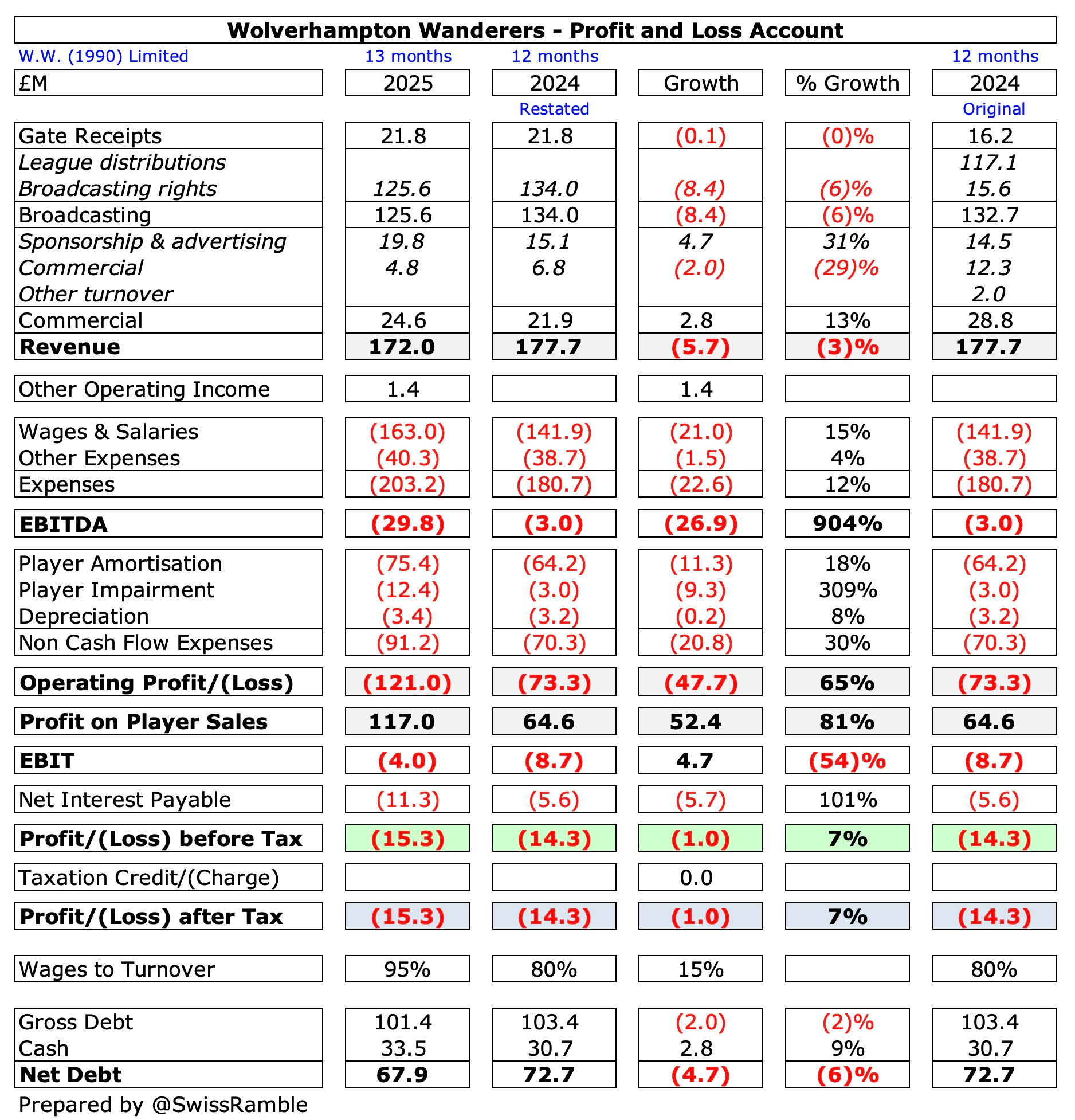
The main reason for the revenue reduction was broadcasting, which fell £8m (6%) from £134m to £126m, mainly due to a lower position in the league. This was partly offset by commercial increasing £2.7m (13%) from £21.9m to £24.6m, while gate receipts were unchanged at £21.8m.
As a technical aside, Wolves restated the prior year revenue comparatives, increasing gate receipts and broadcasting, which was offset by a decrease in commercial. They have not provided a similar restatement for previous years, so growth trends over a longer period will be misleading.
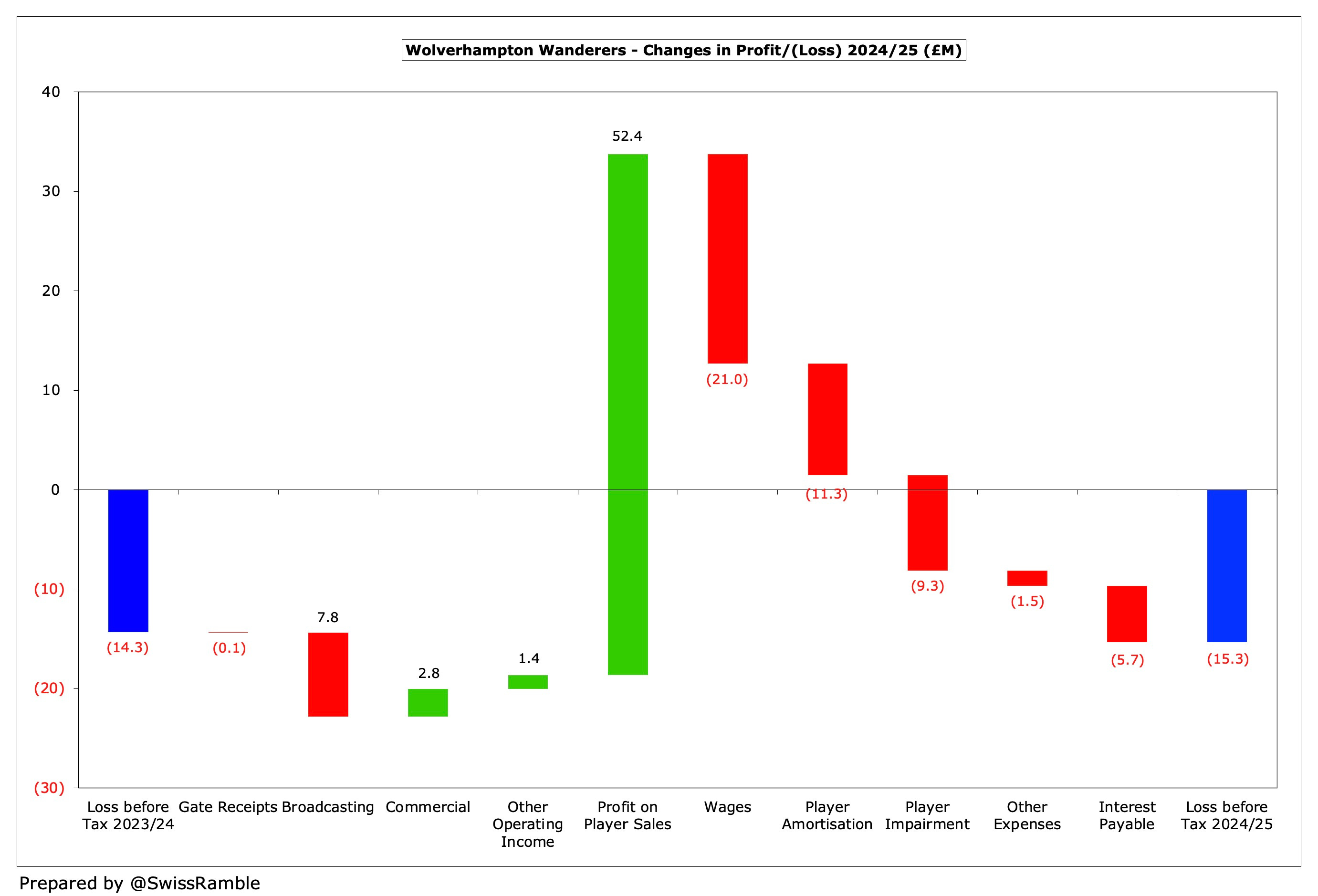
Due to a combination of investment in the squad, new contracts and the 13th month effect, Wolves’ wage bill increased £21m (15%) from £142m to £163m, while player amortisation also rose £11m (18%) from £64m to £75m.
In addition, the club booked £12m player impairment, four times as much as the prior year’s £3m, though other expenses were only up £1m (4%) from £39m to £40m.
Wolves’ £15m loss before tax was mid-table in last season’s Premier League, with many clubs losing significantly more money. Chelsea posted an incredible £262m loss, followed by Tottenham £121m, West Ham £104m, Nottingham Forest £79m and Leicester City £71m.
