

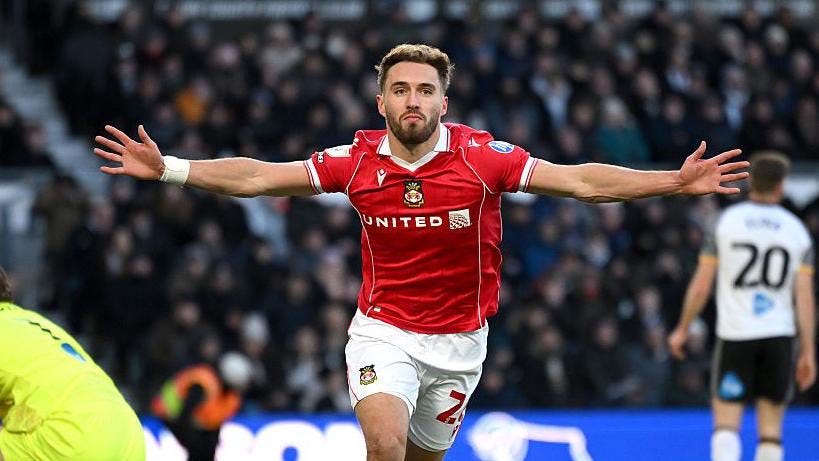
So Wrexham narrowly failed to secure a place in the Championship play-offs, but they did incredibly well in their first season back at this level since 1981/82.
As Phil Parkinson said, “We’ve taken the fight to the wire, it just wasn’t to be on the day. But overall, to finish seventh, on 71 points, is a real achievement in itself at this level.”
The manager added, “Everybody is very disappointed. We were determined to get in that top six. However, I said to the lads all season, we’ve asked for the team to reflect how the team’s played over the last four or five years.”
Owners
It’s been quite a journey for Wrexham since Ryan Reynolds and Rob Mac (formerly McElhenney) bought a team then playing in the fifth tier of the English football pyramid in February 2021. The Hollywood duo paid a token £1 to acquire the club from the Supporters Trust, though they also promised to invest a further £2m.
League Position
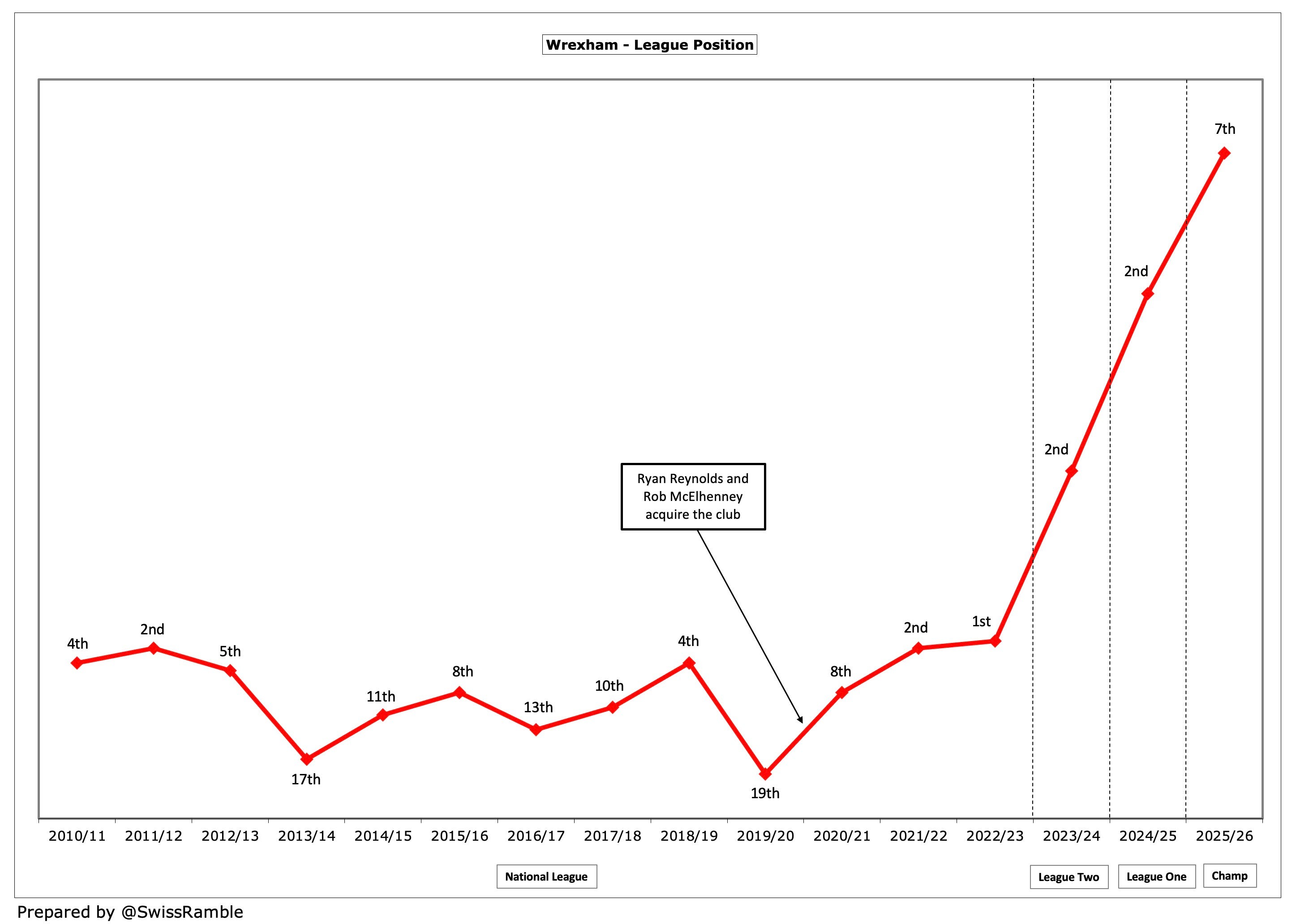
In the short period since they arrived, Wrexham were promoted three seasons in a row, becoming the first team in the history of English football to go from the fifth tier to the second in consecutive seasons.
Although that incredible streak came to an end in 2025/26, their seventh place in the Championship was the club’s best ever finish, overtaking the 15th place achieved way back in 1978/79.
Furthermore, the club spent 15 long seasons outside the Football League before the first of their promotions under Rob and Ryan took Wrexham back to League Two in 2022/23.
As the board observed, “Our overarching objective is to achieve sustained sporting success by progressing each of its senior team through their respective divisions to the highest possible level at the earliest appropriate opportunity.”
Transfers 2025/26
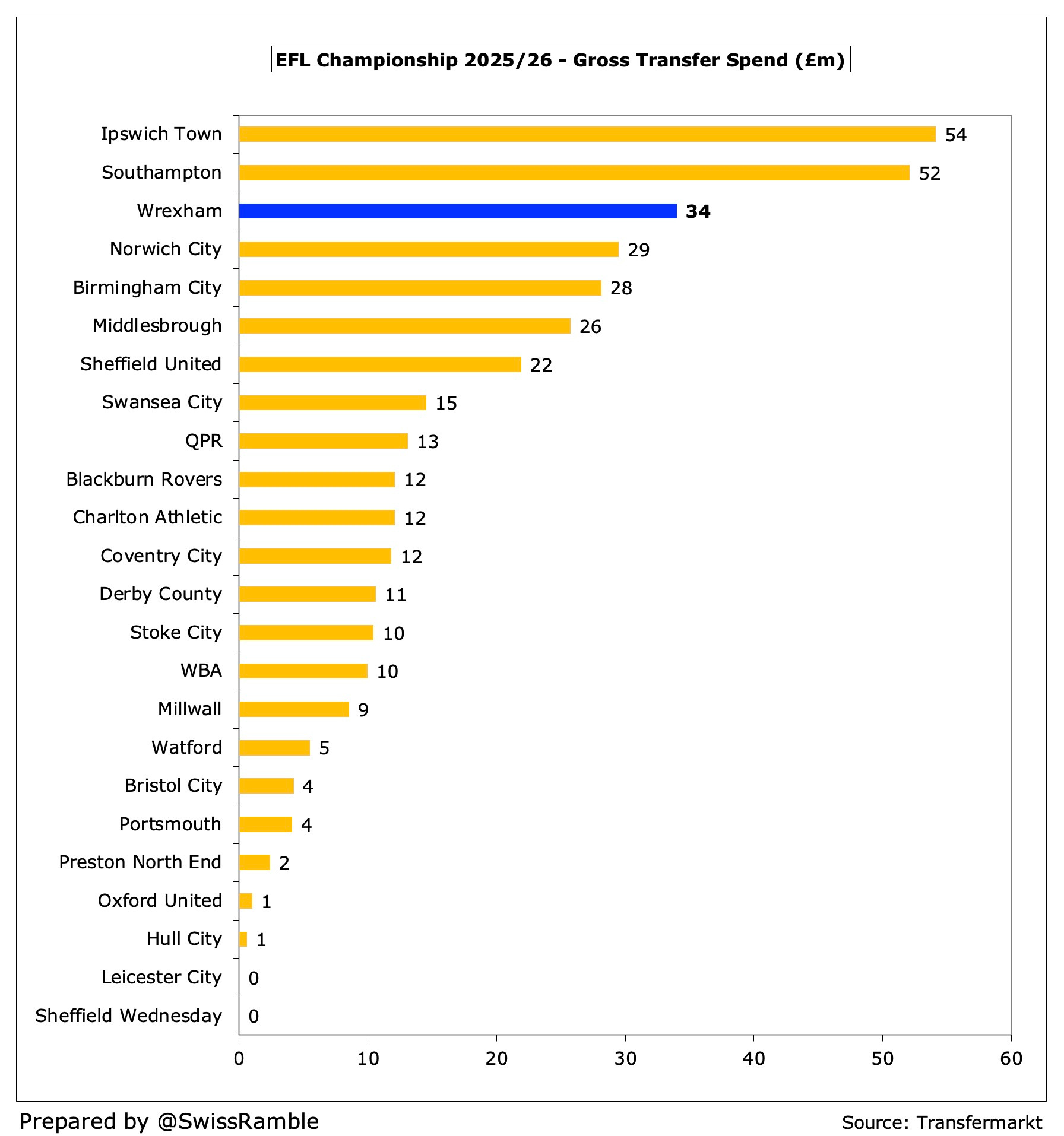
It’s fair to say that Wrexham went for it this season, splashing out £34m on player purchases to strengthen the squad in the Championship, as they brought in the likes of Nathan Broadhead from Ipswich Town, Ben Sheaf from Coventry City, Callum Doyle from Manchester City and Lewis O’Brien from Nottingham Forest.
That was actually the third highest gross spend in the division, only below two clubs relegated from the Premier League the previous season, namely Ipswich Town £54m and Southampton £52m.
Rob Mac underlined the owners’ philosophy, “If I’m being honest, I don’t even know what the word consolidation means”, though he accepted that things were about to get “a little pricier from here on”.
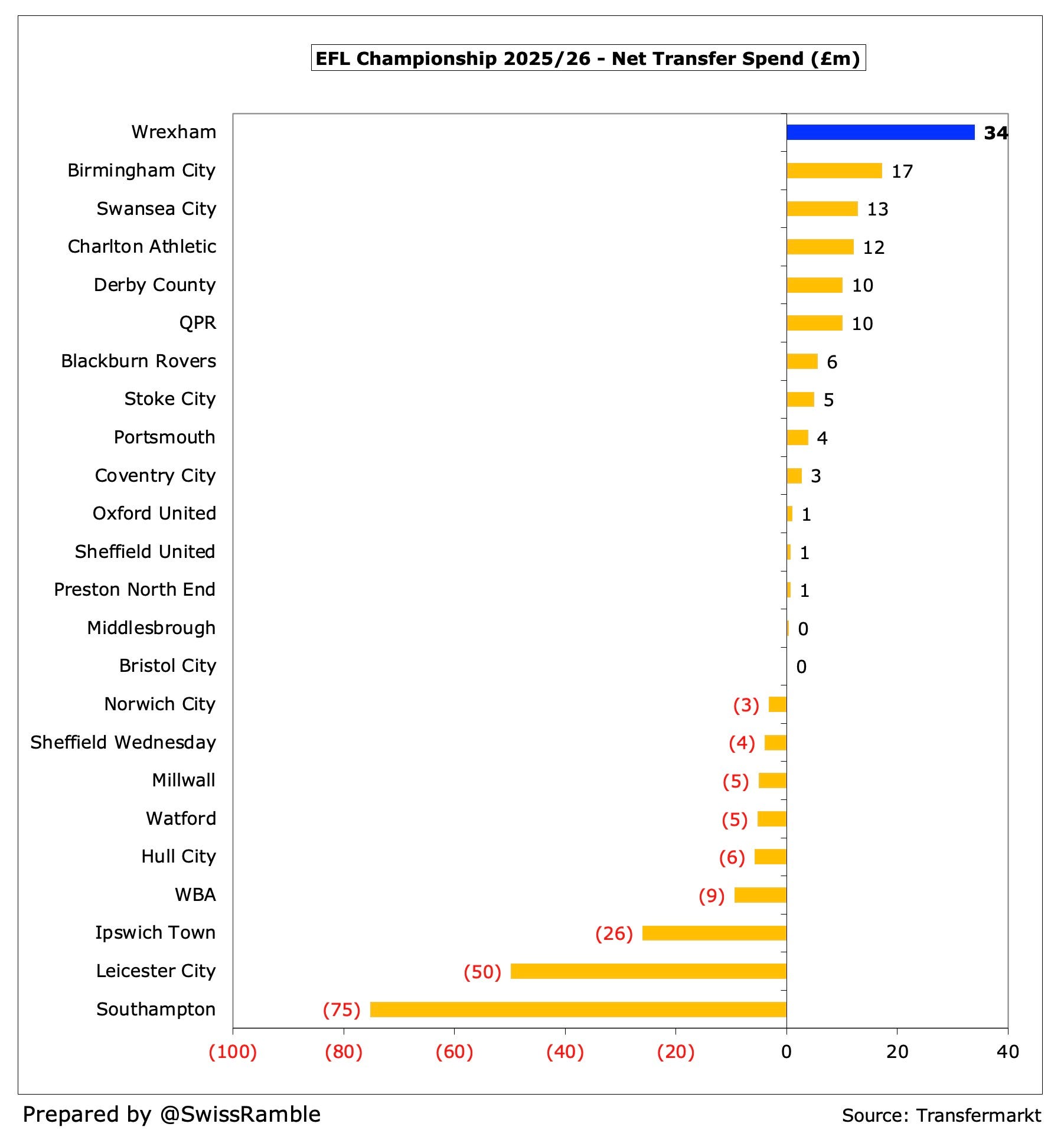
Indeed, Wrexham’s £34m net spend was the most in the Championship this season, at least twice as much as any of their rivals, the next highest being Birmingham City £17m, Swansea City £13m and Charlton Athletic £12m. Three of the top four were the clubs promoted from League One the previous year, highlighting the need to invest at a higher level.
Plenty of players left Wrexham, but they were either on free transfers or loan deals, so no transfer fees were received.
New Investors
Reynolds and Mac have brought in a few additional investors, “who have unique capabilities to help drive progress”.
They first sold a 5% stake to a US consortium fronted by Sam Porter and Al Tylis, which had previously acquired around 50% of Mexico’s Club Necaxa.
This was followed up in October 2024, when the Allyn family, the former owners of medical device company Welch Allyn, acquired 10% through Red Dragon Ventures, a joint project with Reynolds and Mac.
However, what really made people sit up and pay attention was the arrival of Apollo Sports Capital in December 2025, as their minority investment of around 10% reportedly valued Wrexham at a chunky $350m, which is a staggering number for a Championship club.
The co-owners explained the rationale of taking on new investors, “The dream has always been to take this club to the Premier League while staying true to the town. Growth like that takes world-class partners who share our vision and ambition, and Apollo absolutely does.”
Apollo are serious players in the sports business, having also bought a 55% majority stake in Spanish giants, Atlético Madrid. There are obvious similarities between these two investments, as both clubs are driving large redevelopment projects. It’s also worth noting that Apollo’s CEO, Al Tylis, had already jumped on board the Wrexham story.
Even after all these transactions, Reynolds and Mac are still very much in control, as their remaining shareholding is around 75%.
However, it would be no great surprise if they were to sell more minority stakes, reading the club’s strategic report, “Further partners would be considered, if they can add value and assist in the delivery of our objectives.”
Financial Advantages
The influx of new money has promoted accusations that Wrexham have effectively bought their way up the leagues, as it has given them a big financial advantage against their competitors.
There’s an element of truth here, but the story of their success is somewhat more nuanced, as we shall see from a review of their finances.
Season 2024/25
This analysis will be based on the latest available accounts from the 2024/25 season, when Wrexham were promoted from League One to the Championship, after finishing as runners-up to Birmingham City. This returned the club to the second tier of English professional football for the first time in 43 years.
In addition, they reached the fourth round of both domestic cup competitions, only eliminated in the FA Cup by Premier League Chelsea after extra time, while they were beaten by Cardiff City in the Carabao Cup,
Profit/(Loss) 2024/25
Wrexham’s pre-tax loss significantly increased from £2.7m to £15.2m, despite revenue rising £6.6m (25%) from £26.7m to a club record £33.3m, as this was more than offset by a steep rise in operating expenses, which were up £15.6m (54%) from £28.8m to £44.4m.
In addition, the club booked a £3.8m exceptional charge, as funds held with a brokerage company were frozen after it entered administration.
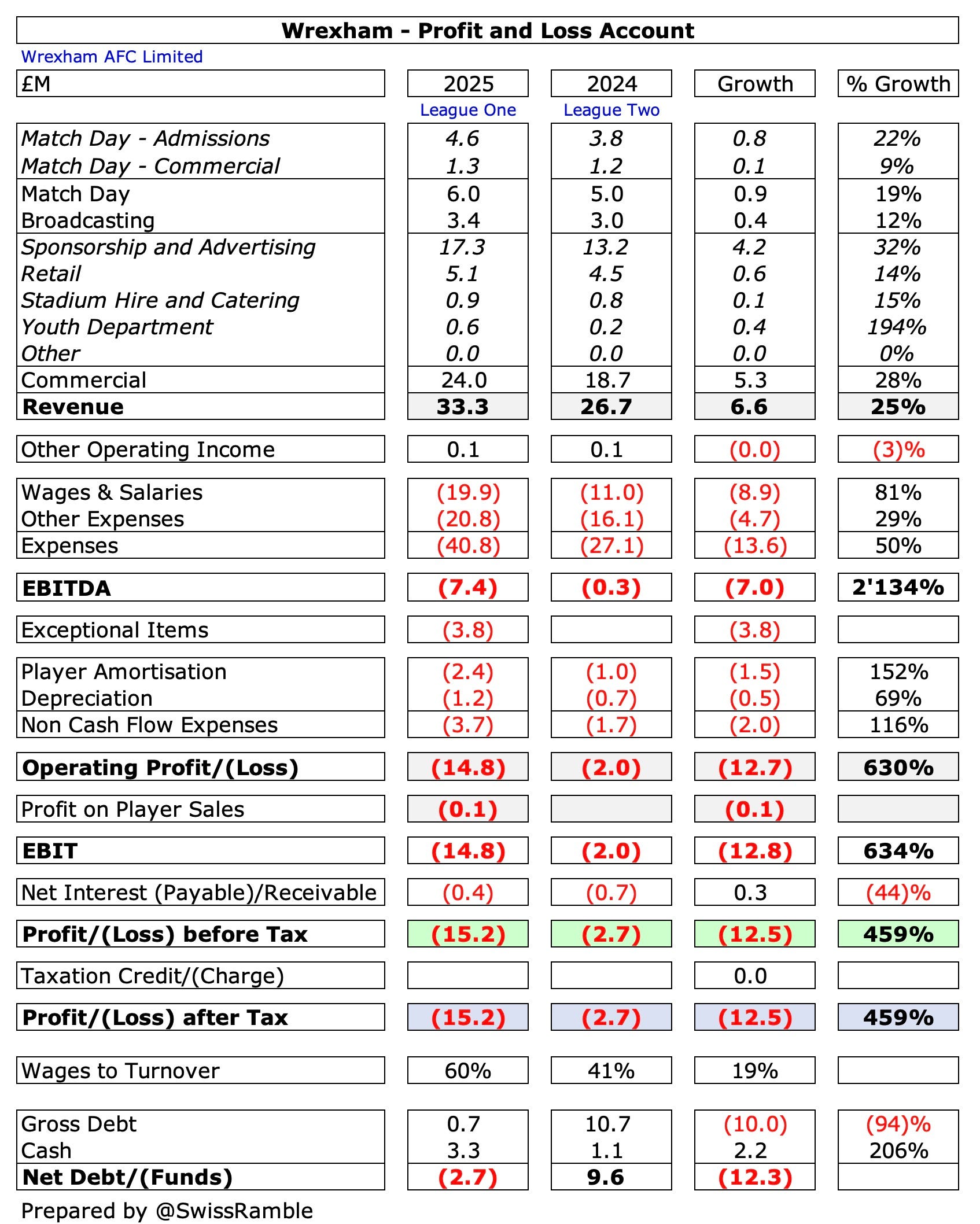
All three revenue streams were higher, though the largest increase by far once again came in commercial, which rose £5.3m (28%) from £18.7m to £24.0m. However, there was also decent growth in match day, up £1.0m (10%) from £5.0m to £6.0m, and broadcasting, up £0.4m (12%) from £3.0m to £3.4m.
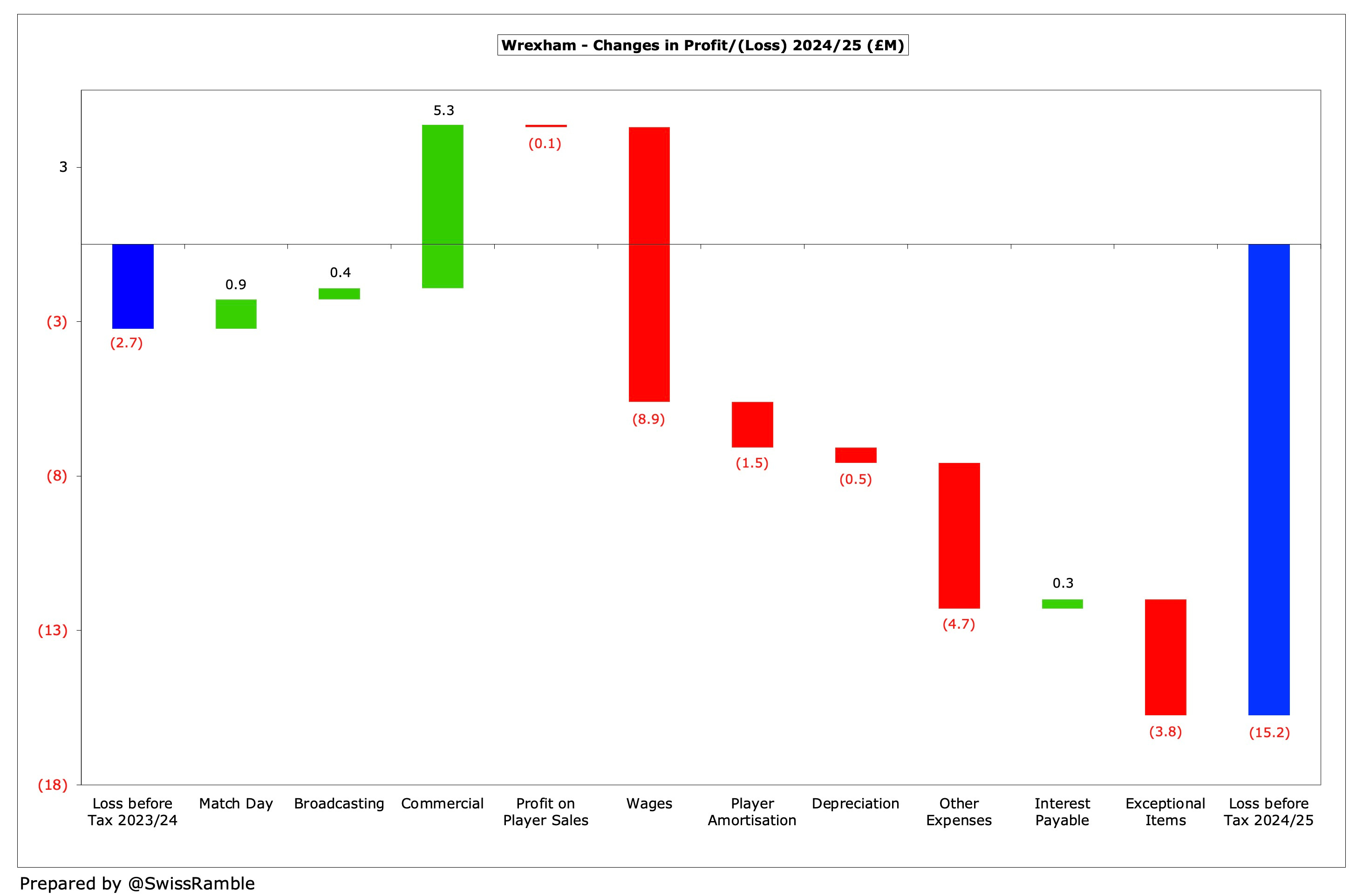
Wrexham’s wage bill shot up £8.9m (81%) from £11.0m to £19.9m, due to a combination of promotion bonuses and investment in the squad. The latter factor also led to player amortisation more than doubling from £1.0m to £2.4m.
Depreciation was up £0.5m (69%) from £0.7m to £1.2m, while other expenses increased £4.7m (29%) from £16.1m to £20.8m.
Although Wrexham’s £15.2m loss was not great, they were far from alone in posting a substantial loss in League One in 2024/25, as five clubs registered double-digit deficits.
Indeed, champions Birmingham City’s £34.4m loss was more than twice as much as Wrexham, while Huddersfield Town and Charlton Athletic also posted larger losses with £22.4m and £15.4m respectively.
